Friday, December 26, 2025

More Models

Since the last post I've been attacking some models and actually finished a couple. It helped that I got laid off in late September so I've had some time. Lots of updates.

Airbrushing

I finally started practicing with the airbrush. I used the cheap ones that came with my compressor to paint the olive drab on the upper surface of an early B-25 Mitchell bomber. I also used it to spray intermediate blue and sea blue on a pair of planes where I was practicing the USN WWII tri-color camouflage scheme. 

I used Squadron acrylic paints and they worked great with the airbrush, both the cheap ones and the Iwata Eclipse I plucked from the Hobby Lobby blowout.

Ok, so I owe Jose Luiz Lopez a half apology for my earlier post where I took issue with his statement that $150 compressor/airbrush bundles were total trash. I'd said that's not true for compressors, and I'll stand by that because the little compressor I got works fantastically. I said the brushes were acceptable and you don't have to spend big bucks to get one. Here's where I own half an apology; the cheap brushes that came with mine are just OK for spraying large areas but they aren't reliable for trying to spray in finer areas and with lower pressure. Tip dry seemed to happen more often with them. However, I've been hearing good things about Gaahleri and other more affordable brushes (starting at $30 on sale), so it's only half an apology because you can still get a good quality brush without spending the hundreds that Lopez indicated you'd have to spend. Even then, I can still use my cheap ones for priming, base coats, and varnishing.

The Iwata is really nice and I'm lucky to have gotten one on sale.

Three Cars

During my "sabbatical" I built three cars in addition to the 280Z I built earlier.

1970 Dodge Challenger (1/25 scale, AMT)

This AMT kit comes from a series of US Postal Service themed sets boxed in collectible tins. I got it because I liked the box but also because I hope to use the car in a diorama for a friend. He owns a 2018 Dodge Challenger Hellcat and an auto parts company. I have an idea to pair this 1970 Challenger with a model of his Hellcat and tie it into a diorama themed for his company.

I started this kit probably somewhere around late summer of 2025, then finished it off during my time off work, wrapping it up mostly in November. It's better than I remembered most AMT kits from when I was a kid, helped probably by being a 1981 tooling rather than a 1960's tooling. It wasn't perfect; there are fit issues putting on the rear bumper and the roof, but a nice build overall. It was my second serious effort at a civilian vehicle after the 76 280Z and I think it turned out ok. 

Lots of lessons learned:
  • Be careful with those Testors spray enamels, especially if they're old. I used a dark red can from that first bundle I bought, and the pressure wasn't up to snuff and the paint came out too heavy and it looked awful. So awful that I stripped the body with mineral spirits and redid it with a different paint.
  • Hobby paints are overpriced. I redid the body with a generic gloss burgundy spray from Ace Hardware. It was $6 for a big can, versus $9 and more for one of those dinky hobby cans. I'm not saying the hobby paints can't be awesome; the little Tamiya lacquer cans spray fantastic! But the Ace stuff went on just fine, and I've been using consumer-grade primers on other kits. But ultimately, I will have to move to airbrushing for more control. It's too easy to over flood areas with rattle cans. 
  • Priming is critical for cars. Car bodies often need a gloss paint. I noticed these can pool up into small groups on untreated smooth plastic. I primed the car body parts with Mr. Surfacer 1000 and it worked great. 
  • Gloss varnish really helps with decals. Really good decals may not need it as much, but some gloss varnish under the decal helps to reduce silvering. 
  • Panel wash is great on wheels. I got panel wash mainly for emphasizing panel lines on airplanes, but a little black wash over chrome wheels will help bring out the details and add shadow where untreated chrome plating would otherwise be too shiny or smooth to show them. It's one of the easiest weathering/detailing tools you can use.
  • I wonder if AMT are ripping us off for as much as they charge for forty-year-old molds (and sometimes older!).
  • I haven't painted the metal frame around the front and rear windshields yet. When I painted the frame on the 280Z, it was really difficult. Since then, during a live chat on Modeling with Mike (YouTube), I learned from some other modelers that using Bare Metal Foil is a much better way to do it. Or chrome pen, but that still requires tricky masking of curved surfaces.
  • I don't know if more recent toolings feature better design, but while cars can go together quickly there are several problematic areas. Getting the body fully assembled and attached to the chassis usually involves some tricky maneuvering to get the body in place, navigating the interior and the engine. Sometimes getting the interior or windows on can be touchy as well. And for bodies that include extra parts, you have to find ways to make the paint homogeneous (on cars, getting that body paint perfect is like 80% of the point of car kits). I'm curious about how newer Tamiya cars go together, there has to be a better design for these things.
  • I haven't yet tried to detail-up the engines. I've seen some incredible work by modelers online where they've added cables, weathering, and scratch-built parts. That's something I'll have to work on; the Challenger was mostly just out-of-box.
  • Car kits are interesting in that many support several build options. So when you're done, there are often many parts left over, including possibly multiple tire and wheel sets, engine parts, and alternate hoods. I've noticed some people save them in a scrap parts pile for later kit bashing or sell them online. 
  • Patience is the number one tool in a modeler's toolbox. Sometimes you have to simply take a day long break from a car kit after laying down a coat of paint so it has time to fully dry.

1965 Chevy Stepside (1/25 scale, Revell)

This is a common kit you can still find at retail, a 2022 rebox of a 1999 mold. I really liked the way this kit came together. It offered options to build it stock or custom; I chose to do the custom edition since it had nicer looking wheels. The box featured a body in metallic green; I did it in gloss green since I didn't have a metallic green and I did have a new can of Testors gloss green enamel spray (yes, I know above I said to avoid these, but this new can kept pretty well and the paint atomized enough to work).

Design was quite different from the other cars I built. Where the others had an interior that came molded in a square bay, this one's interior was a square platform and you added in the sides. The sides had better detail than the sides on the other kits. I found it a bit funky at first, but it did go together very well and its details were easier to paint.

The engine was actually quite fun to build. I sprayed the red color instead of using a marker as I did for the 70 Challenger, so it looks much better. I was able to use the last bit of the dark red Testors enamel that didn't work for the Challenger body but did ok here. I was worried the red was too dark, but over the white primer I used it looks ok. I deviated from the instructions in one way; the custom engine was supposed to use chrome head covers; I elected to use the stock ones because they had the word "Chevrolet" embossed on them, and I brought that lettering out by gently painting on with silver from
an acrylic marker. It looks nice and you can actually read the letters. It's a great touch even though it might not be accurate.

I used two different varnishes on the cab, the hood, and the bed. The bed and hood got shot with Testors Extreme Lacquer Wet Look Clear, which was great. I had a can of Humbrol gloss acrylic varnish that I wanted to test and it was horrible. It went on and dulled the natural gloss on the green enamel paint. So I let it dry then added a light coat of the Testors Wet Look Clear and that helped a bit. But very disappointed in the Humbrol, which I know now should be treated as a matt. What a disappointment from a major name in modeling paints.

The only real issue the kit gave me was the usual wiggly dance you have to do to get the body (cab in this case) onto the chassis. Getting the interior tub, engine, and cab all aligned was pretty tough, but I got it and overall the truck looks pretty close to the picture on the box cover. 

There was one area where I actually improved it over the cover build. The front of the cab body has a part you have to add in. The fit here is quite loose and there is a noticeable gap around the part even after gluing it in. The instructions don't really identify this part until later in the build when you are finishing up the cab so initially I'd painted the cab shell by itself. Even the cover model shows the gap. But I didn't like that look, so I affixed the front piece to the cab, then filled and sanded it, then hit the front of the whole assembly with the paint. It worked great and my build has a smooth front that I think is even better than the box picture. 

The last step was the decals and wow, what great decals Revell put in here. The custom scheme calls for white flame decals around the hood and wheel wells. They all went on beautifully. I'm not sure if it's because the paint was glossy, or because the decals were of high quality, or both. Probably both; the decals behaved really well, no silvering. Not once did they fold up or tear on me, even the long curved parts of the flames. Just a fantastic experience; well done, Revell.

I have to decide if I want to prop open the hood to show off the engine or just glue it closed and join the Society of the Hidden Paint (on Reddit). It might be easier to just shut it. I'll be gifting this one to a local auto shop that did some body work for me. 

M998 HMMWV (1/35, Italeri)

This kit came from the armor lot I picked up summer 2025 from an army vet that didn't have time for modeling anymore. It was an expensive bundle but there were some great kits in it. Since I'm not an armor guy I sold off several of them and made a small profit, but I kept the HMMWV and I built it in desert sand color. 

It's an OK kit. There are fit issues, especially in adding the roof section to the main body, but overall it was fun to build. The kit was missing the clear sprue, but I found a replacement on eBay and was able to get the front windshield and headlight glass that way. I'm only missing the back windows on the rear enclosure.

This was technically my second car after the 280Z but the first military armor I've build in my return to modeling. I accidentally started weathering it when I sprayed the sand color on the wheels and excess went on the tires. That overspray formed the foundation for sand-colored dirt on the tires that I enhanced with a bit more paint. I need to add some weathering to the rest of the body.

This kit will be gifted to my neighbor, an ex-marine who said he liked the HMMWV.

Navy Planes

Got work done on a couple planes I'd started earlier as well. 

PV-1 Ventura (1/72, Academy)

This is a kit I got in a stash a mom was selling that she'd collected for her kids when they were younger. They dabbled in a few of the kits but on the cusp of heading to college now, she needed to get rid of a couple boxes of models that were just collecting dust. I sold off a few of the collectible items, but the bulk of the bundle was 1/72 aircraft, which is my main jam, so I will keep and build most of the kits. The Ventura is the first kit I started.

This kit hails from 1987, a decent molding that's middle-aged rather than vintage, and I found it to be a good kit overall. Form seems mostly accurate, and fit is decent. There were a few tricky parts in building up the fuselage and I was fortunate to have found an Eduard mask set for its several windows and especially for the birdcage canopy. 

As only my second kit in my return to modeling and my second one using an airbrush, I learned quite a bit while applying the navy tri-color camouflage (bottom: white, middle: intermediate blue, top: sea blue).
  • Because I was worried about how to mask the turret guns while painting, I ended up masking off the dorsal and ventral turret areas and not installing them until after painting the body. This worked ok and I didn't have issues completing the construction afterward, but the bottom turret's canopy frames didn't get sprayed with the rest of the bottom so the paint isn't homogeneous, and I didn't realize until late that there was a gap that needed filling and sanding here. I have to figure out how to assemble the guns and mask them so the whole thing can be painted together.
  • The airbrush affords much better control than the spray can, so I didn't mask everything, thinking I could freehand it. I had only masked the bottom white part of the fuselage when painting the intermediate blue layer, then removing it and free handing the sea blue layer. It actually worked OK, but I was premature in removing the white mask, which would have protected that area from any overspray from the blues (and from my damn fingers tracking paint). I should have also masked the intermediate blue layer after it dried because some of the sea blue lightly covered it and darkened it. It was not so bad that I felt I had to strip it or repaint the intermediate blue area, but I won't be entering this one into any competitions.
  • The Iwata Eclipse was used to paint this and I really like the way it sprays with the Squadron paints.
After applying decals, this one is not bad and is pretty close to the box picture. I did not varnish it, but I might and then also try adding some weathering. Both this kit and the Dauntless below are intended as cheap paint mules, but I think I did ok in making them presentable.

SBD Dauntless (1/72, Testors)

This is a super cheap kit with all of about ten parts. It is intended for beginners and the In Scale and Detail review absolutely lambastes it for being terrible. But it cost me all of about $4 and was a great choice to use as a paint mule and a platform for practicing weathering.

As you might expect, it built up really fast. I didn't prime it; just went straight with white spray paint on the bottom, Squadron intermediate blue for the middle, and Squadron sea blue for the top. The tri-color scheme is actually incorrect; based on the decals this is supposed to be an early Dauntless, so it should be blue gray over gull gray. But I really wanted to practice the tri-color scheme. As I had with the Ventura before it, I did not really mask well, but this time around I was more gentle with the sea blue application and the final result is decent. I'm particularly pleased with the way the birdcage cockpit masking came out as it was fully scratch made by me since there were no third-party masks for this kit.

I still have to paint and affix the bombs and then I will practice some weathering. I already added some silver paint with the markers to simulate chipping around the cowl. This is a very easy technique that requires little setup, though the effect isn't quite as good when the paint is applied with a jagged sponge piece. I think practice adding some engine exhaust and some fluid leakage. I may also test some post-painting techniques for adding tonality to the wings.

So far, it was as great choice to cheaply practice. I also did a bit with weathering, which is something I'm new to. I experimented with different colors for panel lines. On the left wing and fuselage, I used a blue gray wash. It didn't really show up very well and the panel lines are very subtle. That's not wrong, but generally pro modelers I see like to make lines with greater contrast although I personally find that simultaneously unrealistic and more aesthetically pleasing.

Then on the right side I used a darker gray panel wash and this, especially on the intermediate blue, provided greater contrast.


The final bit of practice was to also use panel washes on the bottom. The results were the same as before. The blue gray wash didn't really register much, the dark gray was much better. A lot of modelers use black, which I know will create a better contrast, but I wanted to experiment with something different.


PBY Catalina (1/72, Academy)

I started this one but it's a big boy, even at 1/72. I have finished most of the construction and painted the white and intermediate blue layers of the camouflage. I still need to finish the sea blue on top and finish building out the engines and props.

So far one improvement in my technique is that for the Dauntless and Ventura, I went ahead and assembled the props during the construction phase since they way they were designed, you had to have them on to put on the cowlings. And you typically would want the cowlings on before painting. But that meant I had to create these goofy masks around the props to keep them from getting painted (and I didn't want to mess up the black props with yellow tips I'd already done). It worked but did leave the front edge of the cowlings not painted well.

This time I was a bit more creative and used blue tac poster putty to hold the cowlings on the Catalina's engine nacelles. I'll paint the plane, then afterward pull off the cowlings and affix the engines and props.

Pictures to come in a future post.

Wednesday, September 24, 2025

Review: Master Airbrush Instant Aerosol Trigger Handle

When I model, especially as I get into it from a fresh start, I've found that spray cans can be a useful supplement to brush and airbrush painting.

But as I'm older I also don't want to do things that are hard on my hands. Holding down the dispenser nozzle on the spray paint can can get tiring if you do it in a long painting session. I also can't tell you the number of times I've pressed the nozzle only to find that I didn't aim it quite right and paint sprayed off target until I adjusted. 


I picked up the Master Airbrush Instant Aerosol Trigger Handle to help with these issues. This device is sold on Amazon as a pair for about $15. I have also seen similar items sold in singles at local hardware stores.

The device is a handle that you affix to the top of the spray can and it has a trigger mechanism that you can depress with your finger or hand while using a more natural grip. As long as you install it correctly on the spray can, it also allows you to aim the spray. Spray cans are pretty universal in design and this means the handles can be installed on nearly all cans. I like that the clamping mechanism on these that has plier-like pincher handles. I have seen some variations of this tool that have to be snapped on or slipped on, and their less flexible fastening points might be more prone to breakage.

It seems a small thing, but I liked these simple utility items. They did make using the spray cans a little easier and more comfortable to use. They seem fairly durable to me, though not invincible; you will need to take care to be gentle with them as they involve using bendable plastic to secure themselves to the cans. But they should last for many uses and will be useful especially for those with limited agility or grip.

Saturday, August 09, 2025

Notes on Model Painting

All right. I'm nine months into my return to modeling.  

Paints

Paints indeed cost a fair amount as you need many colors and there are many types of paints and accessory items for each. For each brand of paint, modelers recommend getting the manufacturer's brand of thinners, cleaners, and retarders, the argument being that generally speaking the manufacturer would best produce items of chemical compatibility. That makes sense, and most of the time, once you buy a bottle of thinner or retarder, you won't need to buy it again for a long time. So paints and paint auxiliaries add up, but once you're set, you're good for several models. 

I started with the enamels that I got in the big bundle purchase mentioned in an earlier post. After ten years, these Testors paints are still working well. 

But I've been introduced to the acrylics, something I'd never used before. It was quite a relief and very comfortable to work without having to wear a respirator mask and both affordable and easy to thin and clean with just water or isopropyl alcohol. The newer acrylic formulations from AMMO (the ATOM line) and Squadron (Scale Colors) represent an evolution in the paints, where they behave more like enamels and lacquers without being toxic. 

Going forward, I will probably favor acrylics for most work, but my enamels are still useful and cater to my OCD commitment to the sunk cost fallacy (to any overly literal pinheads reading this, that was a joke). The exception might be auto model bodies, where lacquers can provide excellent glossy results.

Airbrush and Compressor

This can be expensive, but should be a one-time purchase that will last you your modeling life. You can go a little cheaper here with off-brands. My experience is that those ubiquitous cheap Chinese air compressors and portable paint booths are actually fine. The general advice is to get a compressor with a tank, but I've also seen many testimonials that for light use, the tankless compressors are sufficient and very affordable and compact.

The airbrushes themselves are all over the map; you can get cheap ones for under $50, and there seems to be no upper limit if you want to get brand name fancy. But the cheap ones now are good enough, and nearly any brush can do well if you are good with masking. There are two kinds of painters out there; the natural talents that can free-hand everything and have great results, and the ones like me that can deliver good results only after using a few pounds of masking tape. The point here is that for all the screaming you'll hear from the modeling purists, a mediocre airbrush can work fine if you know how to prepare.

I love the modeling books from AMMO, and the author of the excellent How to Paint with the Airbrush, Jose Luiz Lopez, teaches you everything you need to know about airbrush use and maintenance. However, I take exception to his assertion that an airbrush setup must be expensive. In chapter 4, on page 37, he states:

"The cheap sets that include a compressor, three airbrushes, hose, airbrush holder, various colours and a painting manual, for $150 USD/130 £ are, bluntly and simply put, money down the drain."

More amenable is the advice of the people at SprayGunner.com who sell brand names like Badger, Iwata, Harder & Steenbeck, and Grex. They note the brand name ones are made of the best quality components, but are also forthcoming that their affordable No-Name brand airbrushes are more than capable. The difference in cost is substantive; a basic airbrush with hose and multiple removeable cups and needle sizes is USD$25 vs. at least USD$100 or more for a premier branded product. 

Here's my main argument to Luiz Lopez: air compressors and tanks are not new technologies. They've been around for decades, if not centuries, and are commodities. Economically, a commodity is something that is an established, common, and mass-produced item. A commodity benefits from economies of scale and is affordable and reliable. So I don't have a problem with the teeming hordes of hobby compressors being sold everywhere. They're bland but affordable and do their jobs, and that's all a modeler needs. 

Where I come back a little to Luiz Lopez's position is on the airbrush. While I do think they can be commodities too, I accept that the higher quality brands probably do use better metals and rubber for their components, feature more precise engineering, and will be better than the generic airbrushes. But I don't bust on the cheap ones as much; they're probably of sufficient quality for most modelers. I also think the generics have gotten better over time and the cheap airbrush of 1995 is not the same as the one in 2025. The No-Name airbrushes at SprayGunner.com have universally good reviews.

13-Nov-2025 Update: I tried out my Iwata Eclipse for the first time yesterday (Hobby Lobby blew them out at 50% off when they stopped carrying them [idiots!] and I managed to get one). Welp, I may need to relent a bit on my previous thought that the use of the pack-in brushes. The Eclipse definitely yielded a smoother and more consistent spray and had better control, especially at lower paint volumes (when you are not pulling the trigger all the way back and using full paint flow). The cheap ones I have are still ok for large areas, and the Eclipse isn't immune to the laws of physics and can still get "tip dry" but clearly some brushes are better than others. But I've learned that some lower cost brands are actually quite good; both Mike Myers of the "Modeling with Mike" YouTube channel and the Squadron guys are endorsing Gaahleri brushes. I will have to try one out someday.

Paint Brush (hand brush)

I still like hand brushing and find it relaxing. It's also more appropriate for small parts. These brushes are readily available in many stores. 

For hand brushes, I find that spending a bit more does help. One of the cheap brushes I got didn't survive more than one use with a brush applied Tamiya lacquer primer. It fell apart during cleaning. The synthetic brushes I got from AMMO are very good, however, I haven't tried them with stronger paints yet. 

I also tried out a silicone brush which is less like a brush than a wedge, but it has proven handy for certain types of detail work.

End Thoughts

My early model building involved no painting at all. I would slap together a kit and its only decoration would be sloppily applied decals and fingerprints of glue. You do not have to paint a model to enjoy the hobby. 

In time though, I would come to appreciate that while building a model gives it life, painting a model gives it a soul. It's a cost you have to pay to make the best of model building.

Sunday, June 29, 2025

Modeling Hack: use War Thunder

In my return to model building, I've been having a good time, but I've also hit some frustrating road blocks, including:

  • Items out of stock: I swear, why is everyone buying out the same paint color I need? It's been a bear trying to get interior green for various airplane cockpits. There must be a bajillion new modelers coming into the fold at the same time as me because I figure you experienced guys already have plenty of paint.
  • Having to pay for tons of shipping: There aren't that many local hobby shops that sell kits anymore. Hobby Lobby is the closest I got, and while they're surprisingly good at some paints and supplies, the model selection is limited. So I have to buy from out of state or drive across the city.
  • Research is trickier than it should be: this is the main driver of today's blog post. I am trying to understand what paints I need and it's turning out to be this weird confluence of historical research, uncertainty, and trying to find paint that's in-stock (see above). 
So about that third point on research. It started with the snap-together Spitfire Mk I kit I mentioned a couple posts back. I just want to know what color to paint the interior and exterior of the airplane, and you'd think that would be simple. But no, it's quite an ordeal. There are many differing opinions on it, and then I learned that in the field during WWII, some airfields were better equipped than others, so it was common for aircrews to just use what was on hand to approximate the colors designated by the air ministry. It turns out that the realistic paint scheme could be one of several, depending on the time of the war, the official specifications, and what teams in the field had to work with. It was really frustrating to spend hours reading messages in forums and books and still not be sure what to do. 

Then I remembered that the guys that built the online game War Thunder were super rivet-counter types and had done a good job recreating aircraft in that game. I popped into the game to try out some aircraft, and there are some excellent examples of paint schemes in there, and they do have examples of many aircraft from all different services. You can see exterior camouflage and then jump into the cockpit on a test flight and see the interior colors and also the details. They even added weathering. 

It's not an exhaustive set of schemes, but I think I do trust the Gaijin guys to have done a lot of research and the colors there are probably pretty accurate and won't embarrass you if you use them as guides. And there is it, in the screenshots below, the interior green used by the Brits.


Eventually, you can find out enough to get started without War Thunder's help. But using WT can save some time if you want a quick reference, in color, right on your PC. And it's free to use. 


Sunday, June 15, 2025

Review: ICM model kit BM-13-16 Multiple Launch Rocket System (ZiL-131)

I'm working on this kit right now. It was an inexpensive throw-in I added to an online order at Micro-Mark and even though 1/72 scale vehicles aren't my thing I figured for cheap it would be good practice. ICM has a good reputation for detail, so why not for less than ten bucks?

Welp, I had no idea what I was getting myself into. This is an early ICM kit, with an impressive amount of detail for a 72nd scale kit, but there were also many challenges.

27-Jul-2025 Update: Review rescinded. Do not buy this kit. I've updated the cons section under "fitment" with the reason this kit was ultimately a DNF (Did Not Finish).

PROS

  • Detail: Most of the parts are really sharp with detail. 
    • The truck cab's outer shell comes molded in a single piece and the front grille has fine slots to represent the gaps between the grill's bars and it's really a good looking part. 
    • The side-mounted rear view mirrors are impressive with super thin plastic mounting rods, but they look pretty good, given the tiny size.
    • The lattice of steel bars used to construct the rocket rack looks good too, though it was tough to build.
    • The kit includes the headlight guards and they look good on the model. In some 1/35 scale kits, you might have to buy third-party add-ons to get this or better versions of it.
    • Building the underside of the truck involves very nearly putting together a whole drive train and differential set. Automobile kits in 1/24 often have a unibody molding for the underside, so again, for a 1/72 kit this is pretty awesome.
  • Cheap: It's a small kit but I think it retails for $16 and I got it on clearance for $6. But even regular price, it's quite affordable by modern standards.

CONS

  • Errors 
    • Instructions mislabel some of the part numbers
    • The spare tire rack has a pair of vertical slats on the outside edges of the rack that appear to help secure the tires, but there's no way you can fit the tires into the rack with these slats on. Even the box art picture doesn't have these, showing just the spare tires protruding beyond the width of the truck.
    • There is a fixture to mount stabilizers on the rear of the truck. The stabilizing struts are glued to a brace that is supposed to fit over the rear width of the main chassis. But the brace is molded to the same width of the chassis, not the roughly 1/8 inch larger that it needs to be. So I had to cut the brace in the middle, glue each half to its respective side on the truck, then fill the gap with a piece of plastic. This error and the spare tire issue reminded me of software where it's pretty obvious the people that design the software don't use it.
    • The rocket rack is an impressive array of I-beam like parts that glue together and fit into the lattice frame. Each I-beam has three small rods molded into it that glue to the next beam. that But some of the moldings are not correct. 
      • One of the I-beams has only short connecting rods so it doesn't go the proper distance to connect to the next beam. 
      • Another I-beam had two rods and was missing a third.
      • The rods on the outer edges of the assembly are supposed to have molded nubs to represent the start/end of the connecting rod. Only one was molded to have it so it provides a nice end cap on one side. There was no other I-beam with the small nubs molded on the one side. As luck would have it, I had made an earlier error in my assembly and placed one of the I-beams out of order; I had to cut the three connecting rods off of that beam to convert it from a male into a female connection. I was able to further cut down the rods and simulate the nubs by gluing these small components on the opposite side of the assembly. I kit bashed from parts in the same kit, if you will. (updated thought: it is possible I incorrectly assembled the first I-beam backwards, meaning the beam that had too-short rods was actually supposed to be turned around so the shorter rods could be the starter nubs I was missing, but the instructions do not indicate this, and if that were the case, how was the back of this part then supposed to be attached to the other beams?).
  • Fitment is a mixed bag overall, but worst in the places that counted most. Some parts went together perfectly. Others were not sized well (such as the stabilizer bracket, noted above), or required tricky assembly. Unfortunately, once I started to put together the final steps, the rocket launcher assembly didn't fit on the chassis well, and the wheels impacted with the wheel well edges. This was a bridge too far, and I officially quit on the kit here. 
  • Instructions: in addition to the errors, it could have done a better job of breaking down the order of assembly, and some parts, like the lattice framework to hold up the rocket rack, could have been broken down into more steps and pictures.
  • Some flash needed to be cleaned up, but it wasn't too bad. 
  • Very fine parts broke easily. When I first reviewed the sprues after opening the box, I was very impressed with the detail ICM was able to put into the plastic kit. This kit does not have any photo etched parts. And I thought, "wow, with detail this good, who needs the hassle of photo etch?". Then as I was working with the long thin rods used for engine tubing or long handles, they would break just from the force of cutting off the sprue. And I would say, "Oh, that's why they have photo etch." Some of these I was able to carefully repair with cement, others I just gave up on.

Conclusion

Ok, so the kit has problems. In addition to the listed cons, I also had a mistake where I swapped two parts that looked very similar, though that's on me for not paying better attention and why I didn't list it in the cons. 

There are also super tiny parts that I either lost or broke. I mention the easily broken ones in the cons, but losing stuff is my fault, and you have to expect some tiny parts in a 72nd scale kit.

This is a kit that I believe is early in the ICM lineage so I can chalk up some of this to youth. I don't know when ICM officially started making models but some reports are that it was in the early 1990s. That's where this kit is from, so it's quite possible the company learned a lot since then and their modern kits are much better.

Would I have bought this kit if I knew better? Yes, I'd still buy this kit. It was quite reasonably priced, I learned a lot with it, its detail is very good for the scale, and if you are dedicated you can build it up into a very presentable model. 27-Jul-2025 Update: NO, I would not buy this kit again, even at one dollar. When I first wrote the review, I had most of the cab and payload assemblies done, and still hadn't done the last step of affixing them to the chassis. I made the mistake of prematurely giving the model a passing grade based on the construction being 90% complete. The cab appears to fit ok to the chassis, but the rocket launcher platform fit is so poor I just gave up. In conjunction with the other errors and fit problems, I have to rescind my previous assessment and issue a DNF on this kit. 

Tuesday, June 03, 2025

Adventures in Model Building

First, apologies for the last blog post. I have no idea what I ate or smoked before I wrote it but it was a weird one. 

Ok, so as I mentioned before I am trying to get back into model building. I'm forty years out of it and have a lot of up-tooling and up-skilling to do. In the last six months or so I've probably spent about $700 to $800 adding knives, adhesives, sanding tools, tweezers, paints, vises, magnifiers, primers, varnishes, and kits to the stash and I've still not gotten an airbrush, which I'm told will change everything.

But I did start with a few of the kits I've gotten and here are my updates.

Meng Models: Titanic

The first kit was a great beginner kit. The Meng Models snap together Titanic kit with colored parts can be built with no glue and no paint. It also has a light kit. My great nephew really loved working on it with me and getting to share his excitement and joy was and is priceless. It's one of the underrated powers of modeling, which many use as a solitary activity for therapy, but can also be used to build memories with others.

That kit went up fast because there was no prep of a workspace or paints. There was no cleanup of paints. There was no having to set up a place near ventilation because there were no glues or paints needed. It was great, and I wish there were more kits like this, designed to be easy to start and easy to finish and that still look good when done. It would help a lot of people get into the hobby. I've heard Bandai's Star Wars Snowspeeder kit is like this: it snaps together, has great fitment, lots of detail, sprues molded in color, and stickers that can add some color. Unfortunately I think it's not in print anymore.

The Meng Titanic wasn't cheap (it was about $50 during a Sprue Brothers Lighting Deal, which means about $100 MSRP) but except for having to handle some very small parts, it was a good kit and the good times I shared with my great nephew are priceless.

Pegasus: Spitfire Mk. I

Interested in getting another kit my great nephew and I could work on, I opted for the snap together Spitfire kit from Pegasus. It's a decent kit for a $12 snap together. It has some nice detail in the panel lining, and a small number of parts limits the complexity. However, it is molded in only one color so we couldn't really start it yet since it will need some painting to be presentable. And as primer and paint work sort of require a partial build of the kit first, it may end up being one that I just build and then give him to display.

I do like the kit though. Obviously it's not going to have the cockpit detail of higher-end kits, but it is a very nice low cost kit. If you're ok with not painting, you can build it in probably 15 minutes. And if you want to put some effort into it, it forms a good test bed for other techniques. You can add riveting to the existing panel line detail, add your own detail to the cockpit (though I doubt any after market parts are available for this kit), and of course a good paint job can add a healthy soul to even the most basic of kits.

This one is currently in progress as I'd like to wait until I have the airbrush to paint it.

Monogram: 1976 Datsun 280Z

This one is personal. In 1976, I was nine years old, and my father bought a Datsun 280Z 2+2. I remember all the neighbors coming over to take a look at it. The Z car's legend is pretty commonplace now, but back then, it had come out as the sports car that everyone could afford. It was very simple with an in-line six cylinder engine and looked a little bit like a Jaguar. TV's Bionic Woman drove one.

My father drove that Z for several years but about 1985, he moved to using the VW Vanagon that we had. It was the perfect time; after all I was getting ready to head to college and what teenager in America doesn't want to have a car?

I would drive that 280Z until about 1990. I had graduated from college and had my first job and would eventually move on to the 1990 300ZX, but that's a story for a different day and a different model. Back then, it was the 280Z that took me to college every day. I went with the Z to visit my friend at UC Santa Barbara, to the San Diego Comic Con, and had a small accident (technically my fault but aided significantly by poor driving on the part of the other person!), but it kept going until I sold it. It had served me and my family faithfully for fourteen years. And except for occasional hassles it was pretty reliable; not bad for a production sports car.

I want to build one as a memento to that past, and found out that there are indeed model kits of the Z car. Unfortunately, there are very few 280Z kits, much less one for the 1976 edition. There are many Z kits still in print, from the 240Z to the 350Z, but the 76 280Z is rare. It does exist; Monogram made one and released several variants between 1976 and 1984-ish but they're hard to find. You can find old Heller or Revell kits online and they're cheap because people know the quality is shit. But the Monogram Z must be in demand because I had to pay an inflated price for the one I found on eBay and it's not a great kit by modern standards.

There are seam lines in spots on the body, sub-optimal fitment on the front end of the car where it connects to the body, and other quirks of a plastic model produced in 1976. It will require work to really make it nice; though it's certainly a serviceable kit and faithful enough to the Z shape and image. I could not find a 2+2 model, so I am making do with the standard coupe. 

I have started sanding areas that need work on the body.

  • There are seam lines down the C-pillar from the roof to the body
  • The front of the car (grille and headlights) is a piece that has to be affixed to the front of the body and needs sanding
  • The body has sharp angles in places where the Z that I remembered had softer curves. I'm sanding the top of the fenders on both the front and back to restore the appearance I remember. The bottom of the back of the car has the same problem so I'll try to soften those edges too.
 There are several customizations I have to apply to this build.

  • The front bumper of my 280Z had two features not on the kit:
    • There were two small rubber blocks on each side of the center. I will have to find some way to make these, perhaps with putty. A couple of the Monogram variants have these so if I can find one for a reasonable price that would be a great way to solve the problem. There's one on eBay now, but the bitch wants $70+ for it and I just can't endorse that valuation. 
    • Mounted on the front bumper's two rubber blocks was a little grill guard rail. That's not on my Monogram kit or any of the other versions of the Monogram kits. I do have reference pictures of other American Z's with this feature, so I figure I can cut and bend a piece of sprue to simulate this and mount it on two other flattened pieces of sprue.
  • The rear bumper had a raised rail that went the length of the bumper. I should be able to simulate this the same way I do the grill guard. 
  • The chrome mag wheels that come with the kit are nothing like the wheels on my Z. I could not find third-party replicas of the same wheels but I did find something close. That's amazing, back when I was modeling as a kid, you could not just jump online and find an alternative 3D printed part. The parts are from the Ukraine, and they're very good quality but I learned the hard way how brittle resin parts are and broke one of them while test fitting. Not too badly though, and I've already painted the wheels silver and they are going to work fine.
I am not doing to try and recreate the 2+2 variant of the Z. No way, not with the skills and tools I have now. That would involve stretching out or extending the body and chassis and probably reworking the rear window frame and window. No thanks, I do not have time for that. 

So far I got the body built. I need to paint the body and interior in order to finish up the build. The Z was silver originally but after a few years the Japanese paint deteriorated badly and my parents had the car repainted in white. I will paint it white to represent the years I had it.

This will be a good kit for practice as I didn't build many car models before. I'm learning a lot. I got a can of Testor's Extreme Lacquer White Lighting which I thought would be an easy way to paint since Extreme Lacquer is billed as a primer, paint, and sealer all in one. But testing it out on a piece of sprue first, I found it goes on thick and the humidity of Houston makes it dry slowly so it tends to drip off a bit. I've since learned that in humid locales you paint in the morning before it gets warmer. I also am beginning to wonder if spray painting will cut it. Maybe it would in a different clime, but I wonder if I'm better off using a primer first, something good like a Mr. Base Coat or Mr. Surfacer or a Tamiya white primer, then airbrushing a gloss white. In fact, I was reading some threads on the internet where one guy said he had luck just using a bright white primer, then adding gloss afterwards. Nothing else, just the primer and the gloss coat. 

Not sure yet what I will do here, but I do know if I'm going to stick with the spray paint, it'll have to be in the mornings, with a good paint booth, and in several light coats. But I have to do this one right. The kit is hard to find so if I mess it up it's hard to recover and start over. It's not like an F-4 Phantom kit that you can find in every hobby shop and garage sale. And it means something to me. I'll make it nice, put it in a display case, and cherish it. 

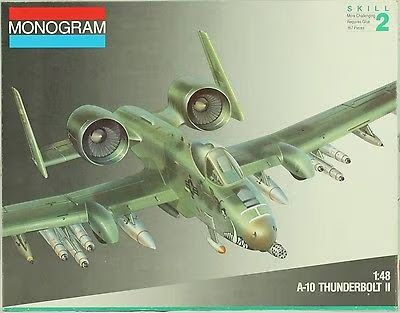
Monogram: A-10 Thunderbolt II (1/48 scale)

Ah, my old friend Monogram again. This is one of the kits that came in a bundle of kits and paints I bought through OfferUp and got me kickstarted back into modeling. I had originally considered selling it since I prefer 1/72 scale, but as the box was already open I figured it would be a cheap kit for more practice. Monogram bills it as a skill level 2 kit, so it is considered easy.

Skill Level 2? MORE LIKE SKILL LEVEL 5! This old 1991 beast from a 1986 molding is a total bite in the ass. I had read in some modeling threads that people think this is a good kit. They have to be kidding me. It's awful. Raised panel lines, poor fitment, and bad design decisions abound here. The guys saying it's a good kit must be referring to accuracy rather than construction quality (there are other 48th scale kits available that are criticized for errors, so that could be it). 

Ye gods. After recognizing the poor fit of the engine parts during dry fitting, I again considered selling it. At a low price, someone else would certainly buy it and I could be rid of the kit's hassles. But I had my glue and workspace set up and just said, "oh, just go for it and you'll have a ready paint mule."

So I continued. I spent about six hours so far on it (better than half that time spent sanding, OMG, this kit). I started some of the assembly for sections that didn't need the fuselage (I hadn't painted the cockpit yet). The engine nacelles are poorly designed. There is a cylindrical piece to show the front of the engine's nose cone and blades and it's hard to know exactly the best way to fit it. You sort of have to just hope that when the top of the nacelle is put on it'll look ok since you can't manipulate it much once you glue the top piece in. The rear of the engine also has problems. There is a piece to mount near the back that serves as a place to glue on the rear engine directional nozzles, but the fitment is very weak and after it was all done my two engine nozzles aren't perfectly aligned. Paint mule. 

I did see these build reports online from these guys:

Most of them found the same problems I mentioned (except for Roberto, who I think was too kind to it). Young and Hodges did mostly out of box builds except for a few changes. Hui did an amazing job, upgrading several parts and scratch modifying the kit's open speed brakes into closed position. The kit really should have made that an option on the brakes (open or closed). It was a strange design decision not to do this.

Hui's build really inspired me to consider saving this paint mule and make it at least presentable. At this point I have to paint and build the cockpit before I can finish the construction. After that I have to decide if I want to go grey or green camo for the paint. 

The kit does have a few high points. First, although I just said the designers should have made the speed brake position an option, providing an open one is very interesting. I think that wasn't that common a thing to show back then. Lots of kits just have a single molded wing; flaps up, end of story. Second, the cockpit detail isn't up to third party upgrade standards, but it isn't awful, especially for a 1986 molding. The overall shape and look of the kit is good and several online have praised the kit for being more accurate than the competition, which makes it a worthy build even with its problems. Finally, the array of included ordnance is formidable. In some kits today you sort of have to go buy third party add-on weapons if you want to have a plane that's ready to ride dirty. Not so with this Thunderbolt II, although the fit on those bombs and missiles will indeed need some work (more sanding!). 

I think in the end it was a good choice to build this one. It caused me to go find Aaron Skinner's video on how to scribe panel lines so I now have a plan to replace this kit's raised panel lines. That may come in handy if I ever run across another classic kit that needs such work.

UStar: 1/144 Soviet T54 MBT

Well, here's something completely different. I have not built many armor kits. But I saw this on sale the other day and figured for a few bucks it wouldn't hurt. There's a growing community around the 144 scale, and with today's manufacturing capabilities, these models are showing up with a respectable level of detail. Plus, it's more practice.

I started this kit today and after spending just a couple hours I'm almost done with construction, but during that time I oscillated between saying "I love you, little 144 kit," and "I hate you, little 144 kit". 

The love comes from the cuteness of seeing this tiny tank you can fit in half your palm. And the quick build of a small kit that has only two small sprues and a photo etch(!) sheet. And from seeing such neat detail on such a kit this small. 

The hate comes from having to work with tiny parts with old failing eyes. Putting the turret's spotlights and machine gun on was an absolute bear. I'm getting nightmares about the photo etch parts that still need to be done. The kit has a few flaws too; there's some flash on a few parts although it's not a lot. A pronounced seam line mars the middle of both tracks. Where light sanding can fix that on some models, I think these track seams must be very deep because sanding and scribing hasn't fully removed them.  Cleaning up flaws on these tiny parts is also tougher than working on the 1/48 A-10's parts.

This will make for a good paint practice though. I can experiment with some of the washes and filters. It'll be easy to store too. And if you want to make dioramas, 144 scale makes it easier to do large scale battles. 

This kit is an experiment and a learning exercise, but it's opening up some ideas and I can see why people like the scale. 

Other Thoughts

So I'm kicking off with a bang and have several projects in the works. Some of them will stall until I get an airbrush; I thought about just hand brushing the first few but then figured, why spend the money on regular paints and spray paints when I will use the airbrush anyway? To be sure, I think any modeler still used mixed styles (brush, airbrush, and spray), but so much of what I've heard is the airbrush is a huge difference maker. While it will take extra time to learn how to use it, and each use requires some setup and cleanup, I think it will make several parts of painting much easier and produce better results. 

I'll have more thoughts on airbrushing later, but in the meantime I've having fun watching thin cement go to work with capillary action, and discovering the joys of sanding. I know, I know, I bitched about sanding in my discussion of the Monogram A-10 kit, but sanding really is quite therapeutic. It doesn't require expensive tools, a laborious setup, or take much time, but you get nearly instant gratification. It's very satisfying to dry fit some parts, see where there are imperfections, and gradually create a perfect fit with just some sanding. I'm particularly intrigued by the use of super-fine grit paper (10,000 and higher) that can be used to polish glass and plastic. 

It's both fun and work, and I can see why lots of people use modeling for therapy (although there can be frustrating moments too). I think I'll have fun with this for a good ten years before I quit to save my eyes. That's the one thing that's noticeably worse this time around; when I was a kid I didn't need magnifiers. Now? I'll have three or four different magnifier devices before I'm done!

Monday, May 26, 2025

Annual Memorial Day Post: Strange New World

This year I didn't really have a plan for the Memorial Day post. I thought I might share thoughts on my adventure to fix a ceiling fan, yet another example of how we cater to the disposable society instead of making it easy to keep existing things alive. But then I thought about how the world's been changing and think maybe it would be more appropriate to ask whether the sacrifice made by our veterans has been  truly appreciated or not.

I don't mean superficial things like saying "thank you for your service," which I'm sure is quite tired and doesn't really do much for veterans anymore (even though they probably do appreciate that you mean well), or making sure you have a flag displayed today or on other honorific holidays.

I mean do you act meaningfully in ways that respect the sacrifice? Not just things on one day, but every day. It can be big things like donating to veterans causes, or simple things like just taking a daily moment to appreciate what you have, rather than worry about how much more your neighbor has. It can be not taking for granted that you have free speech by making sure you have thought through what you want to say rather than wasting it by blathering something to be insulting or hurtful (Harlan Ellison used to say, "You don't have the right to an opinion, you have the right to an informed opinion."). 

Are we making the world in a way that shows we're thankful for it? People are so politically polarized now, and perhaps they always were, but today it seems so many say things just to put others down. Especially in the realm of social media, where people speak by keyboard and they're protected by distance. This deterioration of civility finds its way into other parts of life. I'm not an environmental extremist, but I do care about the environment; I think the earth is a gift to us and we should not so cavalierly pollute it. Even in personal health, there are indications that we're poisoning ourselves with processed foods and insecticides and plastics. The people that have the power to change this aren't using their freedom to do it.

Is this the world our veterans wanted us to build? 

You can be cheeky and say it's the natural order of things. The young today all immediately waggle a finger and say "late stage capitalism," but I'm not sure that's fair. It's not like any other government system was free of issues, and some of the worst were ones that specifically tried to be different from capitalism, then succumbed to the same things that dogs both types: corruption and stupidity.

I've noted before that freedom is a double-edged sword; you can do what you want but so can the bad guy. The law is supposed to be the protection against that, in a society where we accept that what we really want is managed freedom. But the extremes on either end don't like that; they want it their way and only their way and anyone getting in the way isn't worth talking to. It leads to selfish and absolutist behavior that doesn't portend well for the direction humanity seems to be headed.

If you believe in the concept of Pandora's Box, and feel we've opened that trunk and kicked it several times over, then we're indeed walking each day into a strange new world. This direction might not be reversible. Are we throwing it all away on the road to apocalypse? Because that's what happens if the road is one-way; if you can't go back you can only go with adjustments in forward direction. Significant change may only come as a result of disaster; cataclysmic rather than gradual evolution. 

If that sounds biblical, it's because it is. I used to poke fun at things like prophesy and myth but when I look around, I'm beginning to wonder if there's something to it. Humanity's descent into chaos is indeed a prediction shared by both the Bible and The Simpsons. If you believe that, then perhaps it's actually liberating rather than concerning, because it means things are going swimmingly. Just hang on and hope you can cash out the 401k and die peacefully before it gets really bad. Happy Memorial Day!